
Open records, closed doors: a CORA crash course nobody asked for
Reminder: Independent parent group — not affiliated with or endorsed by FASD.
TL;DR
I asked for parent survey data about bell schedule preferences through Colorado's Open Records Act (CORA). What should have taken 15 minutes turned into a six-week saga involving an outside lawyer who responded to the wrong request, a Board point person who didn't realize it, three missed deadlines, fees the school can't legally charge, a Family Educational Rights and Privacy Act (FERPA) argument that the Colorado Freedom of Information Coalition (CFOIC) called incorrect, and an Excel file that arrived initially unreadable. I eventually got a redacted spreadsheet — and when I asked for the legal basis for the redactions, the best the lawyer could find was guidance about reporting student standardized test scores. Applied to a voluntary parent survey about what time school should start. The experience exposed a simple truth: FASD has no CORA process, no designated Custodian of Records, and no fee policy — all of which are required by law. The good news is these are straightforward fixes — and fixing them would reduce cost, confusion, and risk for everyone.
Parent Recap (What Happened)
“If you want the context for why I requested the data in the first place (and what was missing from decision materials), see Bell schedule change - what’s in the Board materials (and what’s still missing).
The short version: after the Board voted to shorten the school day, I requested the supporting materials and survey data. The school provided a spreadsheet of all 149 survey responses — but blanked out the columns that would let anyone distinguish parent responses from staff responses. When I asked for a parent-only extract, things went sideways.
I submitted a second formal CORA request on January 25 asking for less data than the school had already given me: the same spreadsheet, minus 23 staff rows and 5 identifying columns. The school's outside lawyer responded on January 26 — but to my first request, not the second one. He'd left his draft response in his outbox by mistake. When I pointed this out, the Board point person emailed me a few days later asking if I'd received the lawyer's response — apparently unaware the lawyer himself had already confirmed it addressed the wrong request. From there, the statutory deadline passed without a response, the lawyer estimated 4–5 hours and $124–165 in fees that I would need to pay for what amounts to filtering rows and deleting columns. Delivery was promised for February 6 and didn't arrive, the file that eventually came through on February 12 was initially unreadable. The lawyer suggested sending a PDF instead of the spreadsheet I'd requested, and when I asked for the legal citation, the lawyer spent a week searching and ultimately cited guidance for student standardized test score reporting — not parent surveys..
I consulted the Colorado Freedom of Information Coalition (CFOIC), whose Executive Director confirmed: FERPA doesn't apply to voluntary parent surveys about logistics, removing columns from a sortable record is not "creating a new record" under Colorado law, and FASD cannot charge CORA fees without a published fee policy — which it doesn't have.
The full correspondence is linked below so you can judge for yourself whether this process was reasonable.
Board Correspondence: The complete email thread between me and the Board/Board point person from the initial January 5 request through February 10. View Board Correspondence (PDF)
Counsel Correspondence: The complete email thread with FASD's outside lawyer from January 26 through February 13. View Counsel Correspondence (PDF)
CFOIC Correspondence: My exchange with the Colorado Freedom of Information Coalition, including their analysis of the FERPA, fee, and "new record" issues. View CFOIC Correspondence (PDF)
Sample of the redacted parent survey data. The dark cells were suppressed under "Small Cell Suppression n<16." The visible cells were not. Notice which responses survived the redaction process — and which didn't.
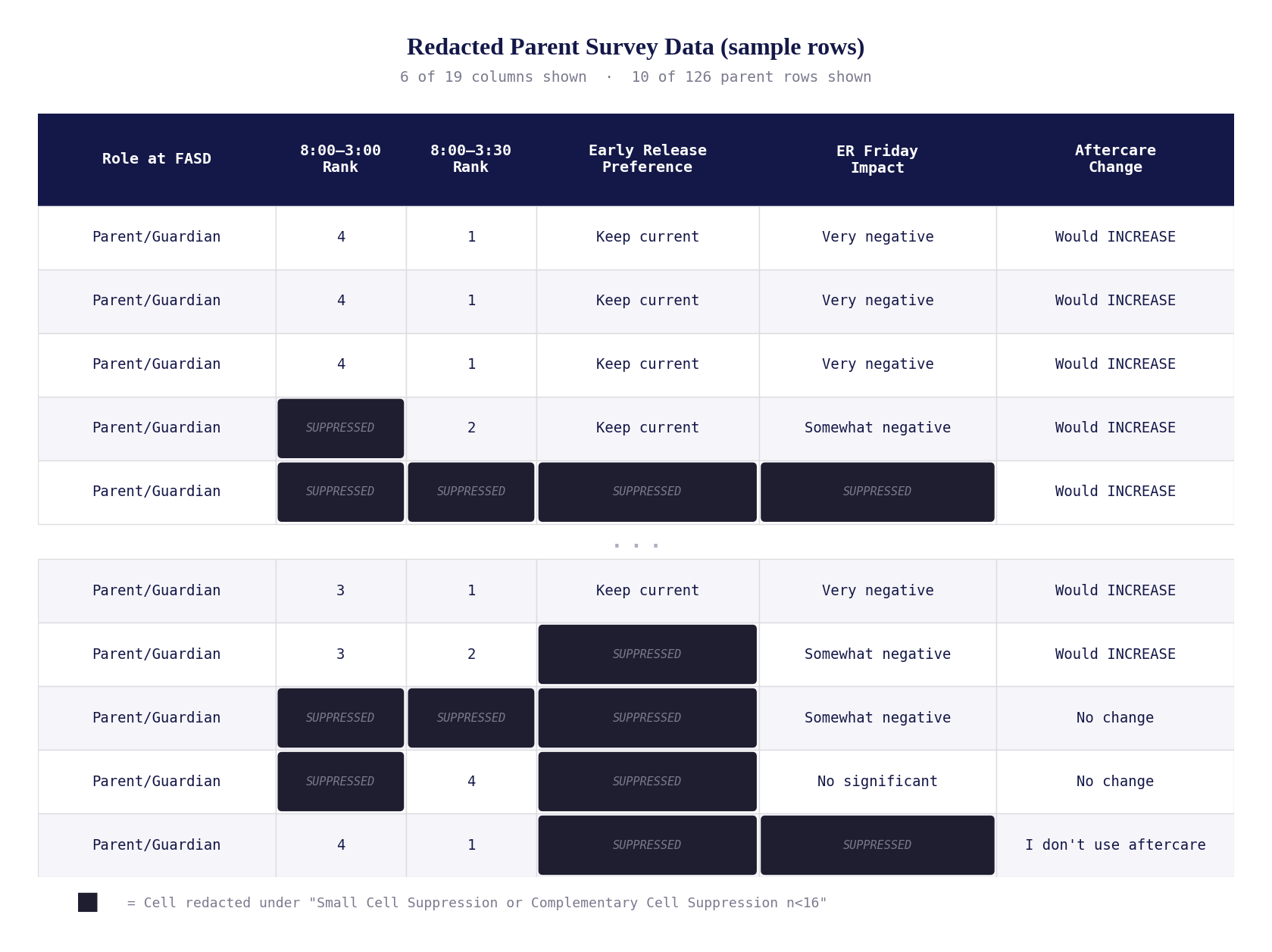
Source: “IRENE & Kiana Work Product for Counsel Bill Bethke.csv”
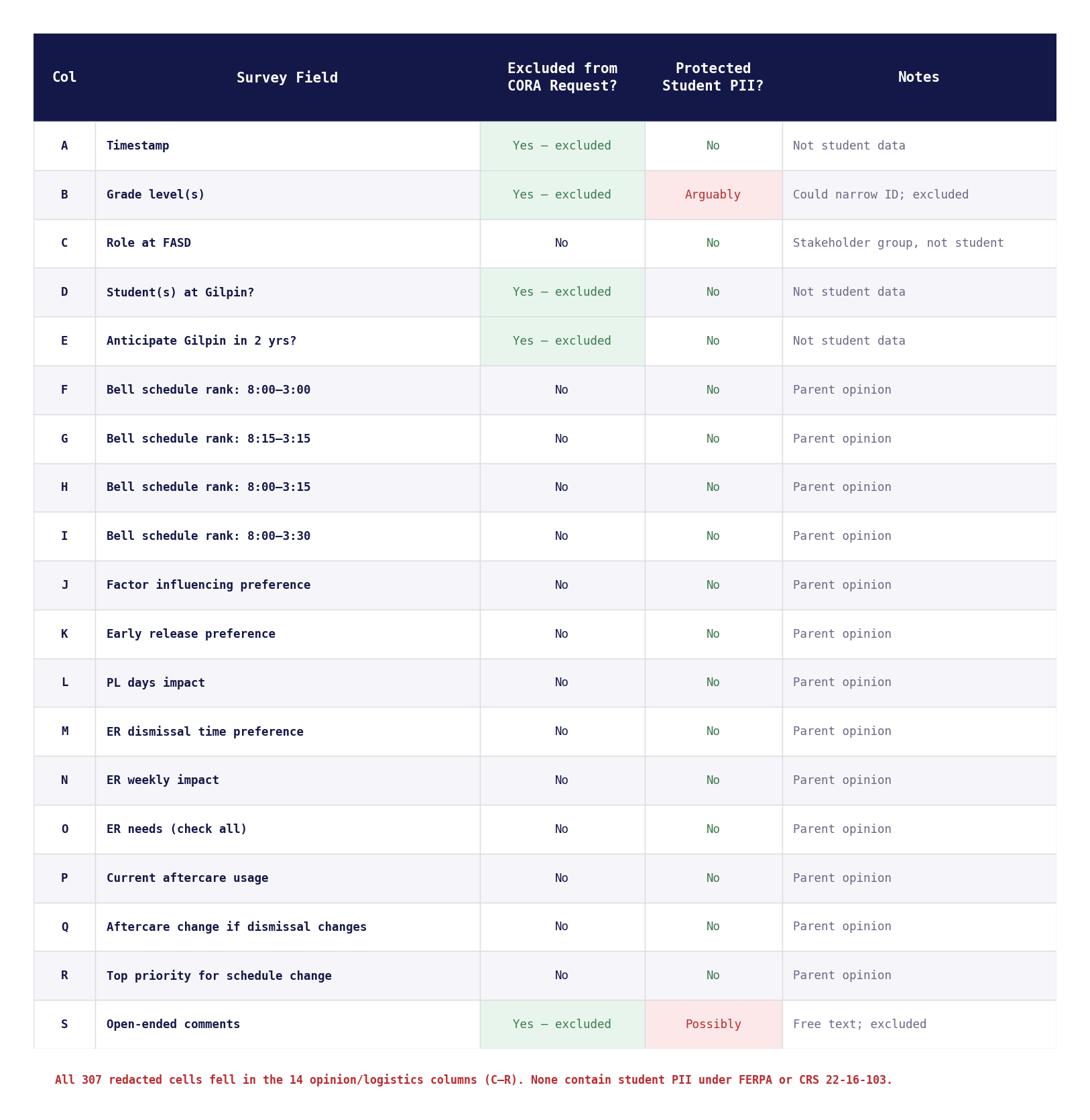
Survey fields: what was asked for, what is protected student PII. I asked for 5 of 19 of the fields to be excluded to preclude any sort of privacy issue. None of the remaining 14 fields contain protected student information.

The “Since You’re Here…” Section
Unofficial reflections — offered in good faith (and with a grain of salt)
I want to be explicit: the section above is my attempt to keep things factual and balanced. This section is my personal perspective.
I'll let readers draw their own conclusions from the correspondence about what happened and why. What I will say is this: it should not take over six weeks, an outside lawyer, three missed deadlines, and a FERPA argument that CFOIC said does not apply — to produce a filtered spreadsheet that contains less data than what the school already handed me.
On February 19, counsel provided his legal justification for the redactions. It raises two arguments, and neither holds up.
First, his FERPA argument centers on the need to protect parent names from disclosure. But parent names were never part of the survey data. The survey didn't collect them. I didn't ask for them. They don't exist in the file. If you look at the field-by-field table above, you can see exactly what's in the survey: bell schedule rankings, early release preferences, aftercare needs, and similar logistics questions. Counsel appears to have written a lengthy legal analysis about protecting data that isn't in the record — which suggests he never looked at what fields the survey actually contains.
Second, the n<16 suppression rule he cites comes from Colorado's ESSA Consolidated State Plan — guidance designed to prevent re-identification of individual students from standardized test score reporting broken out by demographic subgroup. That's a legitimate privacy concern in that context. It has no application to a voluntary parent opinion survey about what time school should start. The 307 cells that were actually suppressed all fall in the 14 opinion columns — none of which contain student personally identifiable information under any definition in FERPA or Colorado law.
It took nearly four weeks from my second CORA request to receive a redacted file, and another week beyond that to receive a legal justification. The justification doesn't match the data. The difficulty of obtaining something this basic — from a voluntary logistics survey, with no demographic information — should give the Board pause.
This is solvable with basic governance hygiene. Three suggestions:
Establish a CORA policy and Custodian of Records. Colorado law requires both. The Colorado Charter School Institute publishes a sample CORA policy that would work as a starting point. Designate one person to coordinate responses and ensure statutory timelines are met. This alone would have prevented most of the confusion documented below.
Lean into transparency. Proactively posting board packets, decision materials, and de-identified survey results costs the school almost nothing — and eliminates the need for parents to file formal requests in the first place. If the materials were appropriate for Board review, they're appropriate for community review (with proper redactions for personnel and privacy matters). Transparency isn't a threat to good governance; it's what makes good governance possible.
Take a critical eye toward external counsel and consultants. The school's attorney incorrectly applied FERPA to a voluntary parent survey, proposed fees the school has no legal authority to charge, couldn't locate the CDE guidance he cited as the basis for denial, and when he finally produced a citation weeks later, it was guidance about student test score reporting under ESSA — applied to a voluntary parent opinion survey that contains no student data. CFOIC — a free resource — provided more accurate legal guidance in a single email than outside counsel delivered over six weeks. If we keep paying for advice that creates problems rather than solving them, we'll keep wasting time and money. The Board should be asking whether its outside advisors are providing value commensurate with their cost — not just on CORA, but across the board.
~ Greg
Want to learn more?
Questions about CORA compliance, the Board’s decision making process or how the school is spending on outside counsel? The Board can be reached at board@fasdenver.org.
Interested in seeing how the Board operates firsthand? The next Board meeting is Wednesday, February 25 at 6:00 PM. Zoom details are available on ClassDojo or here.
Letter to the Board (February 9, 2026)
My full escalation letter to the FASD Board documenting the timeline, issues, and concerns.
—————-
Subject: January 26 CORA Request – Board Should Be Aware of Ongoing Issues
Dear FASD Board,
I’m writing to make you aware of an ongoing situation involving my CORA request for parent survey data. I believe the Board should know what is being done in your name and at what cost to the school.
Timeline Summary
January 5 – Initial CORA request submitted for board packet materials and survey data
January 15 – School provided full 149-record survey spreadsheet, along with other requested board packet documents
January 21 – Board point person, citing school counsel, rejected my request for a parent-only subset of the data already provided, claiming FERPA and CDE “15 or fewer” suppression guidelines prohibit release
January 25 – Submitted second formal CORA request for a 126-record parent-only subset with 5 columns removed
January 26 – Received communication from FASD counsel, which confirmed it was in response to my January 5 request — not the January 25 request
January 29 – Statutory 3-day deadline passed with no response to the January 25 request
February 3 – School’s lawyer estimated 4–5 hours of work and $124–165 in fees; committed to Friday (Feb 6) delivery
February 6 – Nothing delivered
February 9 (today) – Lawyer reports work “proved more complicated than hoped,” with no new timeline
What I’m Requesting
A subset of data the school already provided me, with:
23 rows removed (keeping only “Parent/Guardian only” responses)
5 columns removed (A, B, D, E, S — timestamps, grades, and free-text responses)
With these five columns removed, all demographic data is eliminated and only survey response questions remain.
I am asking for less data than the school already gave me.
Key Issues
1. Legal Analysis
I contacted the Colorado Freedom of Information Coalition (CFOIC) for guidance. Their Executive Director confirmed:
FERPA does not apply to voluntary parent surveys about logistics
Under C.R.S. 24-72-203(3.5)(d), removing columns from a sortable record does not constitute creating a new record
The school’s counsel has argued that releasing even this subset could allow “back calculation” of small cell values. CFOIC’s Executive Director confirmed this concern does not apply when entire columns are removed, since the identifying fields simply are not present in the export. Counsel has dismissed this expert guidance, stating he “doesn’t 100% agree,” but providing no legal authority for his position.
2. Costs to the School
The lawyer stated the school has spent “10+ hours of paid or volunteer time” on this request. For what should be a 15-minute operation (filtering rows and deleting columns), this represents significant unnecessary expense. At typical hourly rates, this could easily exceed $3,000 in legal fees alone. I have offered multiple times to walk staff through the Excel steps on a brief Zoom call at no cost.
3. Fee Authority
Under C.R.S. §24-72-205(6), a custodian may only impose research and retrieval fees if it has previously published a written fee policy. FASD has no such policy. The $124–165 fee estimate cited DPS’s published rate, which does not apply to FASD.
4. Missing Infrastructure
FASD has not:
Designated a Custodian of Records (required by C.R.S. §24-72-202(1))
Published a CORA fee schedule or policy
Formed a School Accountability Committee (required by statute)
These gaps are creating unnecessary complications, expense, and potential legal liability.
Why I’m Bringing This to the Board
I’ve tried to handle this constructively for over a month:
Refined my request multiple times
Offered to walk staff through the Excel steps for free
Obtained expert validation from CFOIC
Been patient through three missed deadlines
The Board should be aware of what is happening in your name — particularly given:
The potentially significant legal expense being incurred
The statutory deadlines being missed
The expert guidance being ignored
The legally dubious arguments being made by the Board’s counsel
I’ll leave it to the Board to assess whether this pattern of responses is consistent with the community engagement goals in FASD’s strategic plan.
I am not asking for special treatment — I am asking for compliance with Colorado’s Open Records Act and for the Board to be aware of governance gaps that affect all parents. The lack of basic CORA infrastructure puts our school at risk if a less patient, more litigious parent were to have an experience similar to mine and raise the issue with DPS, our school’s authorizer.
Attachments
I am attaching the complete email correspondence so you can see the full picture:
Part 1: Initial CORA request (Jan 5)
Part 2: Board responses and data delivery (Jan 8–14)
Part 3: Rejection under FERPA and CDE guidelines (Jan 15–21)
Part 4: Second formal CORA request (Jan 25)
Part 5: Correspondence with FASD counsel (Jan 26–Feb 9)
Part 6: Board coordination issue — confusion between the Board Chair and counsel regarding which request had been addressed (Jan 30)
Part 7: Colorado Freedom of Information Coalition guidance (Feb 2)
Community Survey Spreadsheet: The dataset the school provided on January 15
Sample CORA Policy: Published by the Colorado Charter School Institute
Please let me know if you have questions.
Respectfully,
Greg
Resources
Colorado Freedom of Information Coalition: coloradofoic.org — Free guidance on CORA compliance
"Bell schedule change - what’s in the Board materials (and what’s still missing)?" (earlier FASDads post): fasdads.org/schoolupdates/bell-schedule-board-materials
