
Bell schedule survey: what 126 parents actually said
Reminder: Independent parent group — not affiliated with or endorsed by FASD.
TL;DR
This post summarizes the parent-only results from the FASD Community Bell Schedule Questionnaire (n=126). Full charts and filters are available on the Parent Survey Dashboard.
Bell schedule: 8:00–3:30 is the clear #1 choice (60 of 126 parents, 48%, ranked it first; best average rank: 2.13 of 4). The two shortest days finished at the bottom, with 8:00–3:00 finishing last (61 of 126, 48%, ranked it dead last).
Weekly early release Fridays: 74 of 126 parents (59%) oppose; 40 (32%) support; 12 (10%) have no preference.
Different constraints drive each camp: “Keep current” parents cite work schedule compatibility most (49%), while “early release” parents cite student wellness and family balance most (62%).
Cost shift: 69 of 126 parents (55%) said earlier dismissal would increase their aftercare needs. Among heavy aftercare users, that figure is 76%.
CORA redactions: The suppression pattern in the CORA production had a consistent effect — it removed positive/pro-change responses while leaving status-quo/negative ones visible. Details below.
Question by question results can be found here: [Parent Survey Dashboard]
Parent Analysis (Recap)
The community survey included responses from multiple stakeholder groups. The analysis below focuses specifically on parents/guardians (n=126).
1. Bell Schedule Preferences
Parents ranked four schedule options from 1 (most preferred) to 4 (least preferred).

The 8:00–3:30 option — the longest school day with the most instructional time — was the clear winner. 60 parents ranked it first, giving it the best average rank of any option (2.13). The 8:00–3:15 option was the most consistent second choice, with 65 parents ranking it #2. The 8:15–3:15 option (the one the Board chose) was polarizing, splitting parents nearly evenly across all four ranks. And the 8:00–3:00 option finished last overall, with 61 parents ranking it dead last and an average rank of 3.00. So what: parent preference, on balance, points toward more instructional time rather than less.
2. Early Release Fridays
Parents were asked whether they prefer the current structure (no weekly early release, with more full professional learning days spread across the year) or a new structure with weekly early release Fridays.

The majority of parents (59%) prefer keeping the current structure. 32% favored weekly early release Fridays. 10% had no preference.
When asked how weekly early release would impact their families:

54% reported it would have a negative impact, while 28% said it would be positive. Among parents who were asked about their preferred early release dismissal time, 69% said 2:00 PM and 27% said 1:30 PM. So what: early release is a minority preference, and perceived impacts skew negative.
3. What Drives Parent Preferences
This is where the data gets interesting. The overall top factors driving bell schedule preferences were work schedule compatibility (47%), transportation logistics (16%), and sibling school schedules (15%).
But when you split parents by their early release preference, two very different profiles emerge:
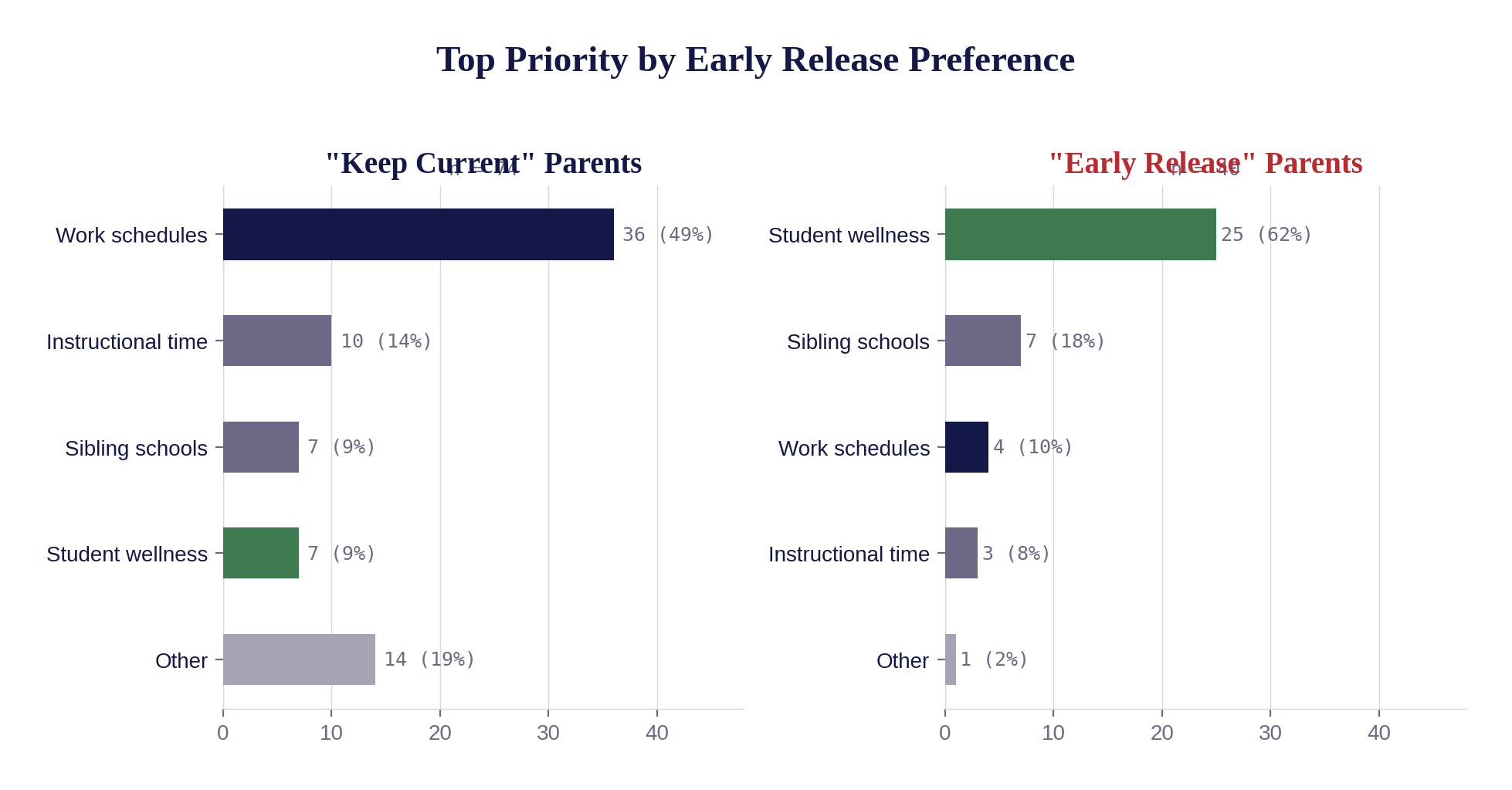
“Keep current” parents are driven primarily by work schedules (49% said it was their top priority). “Early release” parents are driven by student wellness and family life balance (62%). These aren’t two sides of the same coin — they’re two different sets of family circumstances leading to different conclusions. Both perspectives are legitimate.
4. The Aftercare Impact
The aftercare data is important because schedule changes have direct financial implications for families.

55% of parents said earlier dismissal would increase their need for aftercare — a cost that families bear directly. Only 2% said it would decrease their need. The data also shows that “keep current” parents are significantly heavier aftercare users (50% use it 2+ days/week) compared to “early release” parents (32%). This makes sense: families less dependent on aftercare are less affected by schedule changes. So what: earlier dismissal would shift costs and logistics to families who already rely on aftercare.
5. What the Redactions Hid
FASDads obtained the survey data through a Colorado Open Records Act (CORA) request. The CORA production — which took over a month and involved outside legal counsel — contained 307 redacted cells across 126 rows, citing “Small Cell Suppression” under FERPA and a “Colorado practice, less-than-sixteen” (n<16) threshold.
Because the school had previously provided an unredacted version of the survey file, we were able to match each redacted row back to its original and restore the suppressed values. Here’s what the suppression pattern looks like:
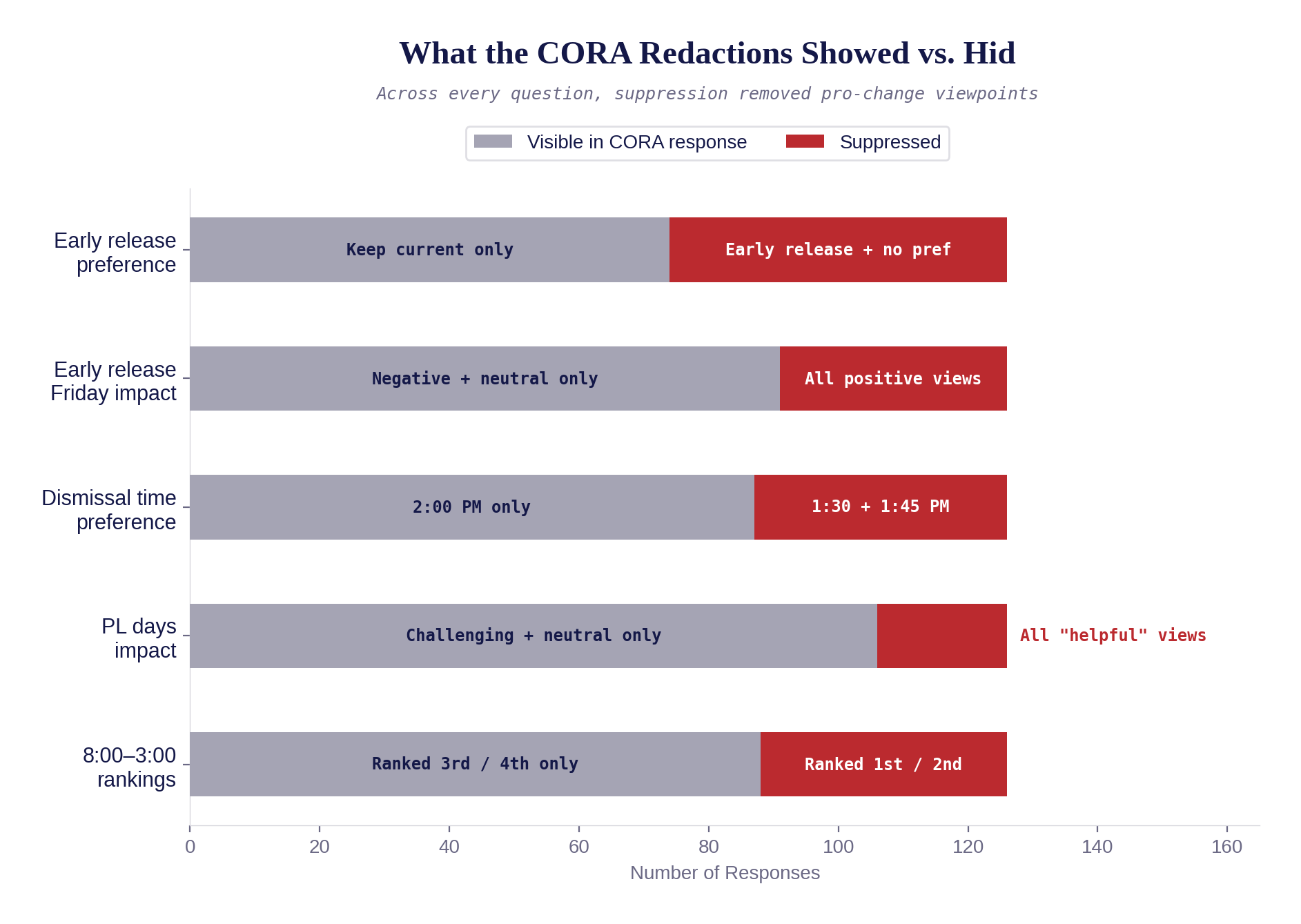
So what: The school spent over a month and engaged outside legal counsel and consultants to redact survey responses under a questionable interpretation of student data privacy laws — applied to a voluntary parent opinion survey that contains no student records. The irony is that the redactions didn't change the bottom line: even the visible data showed parents preferred the longer day and opposed early release. The suppression accomplished nothing except delay, cost, and an erosion of trust in the process.

The “Since You’re Here…” Section
Unofficial reflections — offered in good faith (and with a grain of salt)
I want to be explicit: the section above is my attempt to keep things factual and balanced. This section is my personal perspective.
1) The segmentation question is answered — and it matters
In January, I flagged that the blended survey results couldn’t distinguish parent preferences from staff preferences. The parent-only data confirms that concern: the signals are meaningfully different, and they all point in the same direction. The blended results softened these signals. The parent-only results do not.
2) Teachers supporting a shorter day is rational — and that's exactly why the segmentation matters
I want to be clear: I do not fault any teacher for wanting a shorter day. If you’re working long hours with insufficient support, you will rationally want a change that provides relief. That’s not a criticism — it’s an acknowledgment of a real problem.
But that’s precisely why segmentation matters. The survey asked respondents to identify their role, and the parent-only view looks meaningfully different from the blended results. Based on what’s been shared publicly so far, I haven’t seen evidence that the results were analyzed and communicated by stakeholder group when decisions were being discussed. If that analysis exists, publishing it would help rebuild trust.
I raised this concern in January. The data now confirms it was well-founded.
3) It's hard to see how parent input was meaningfully considered
Parents ranked the longest day first, and the shortest days last. Yet the direction of the schedule change moved toward less instructional time. Parents opposed weekly early release by nearly a 2-to-1 margin, but leadership has said it remains on the table for future consideration. And a majority of parents said earlier dismissal would increase aftercare costs — a concern that does not appear prominently in the stated rationale.
I’m not arguing that parent preference should be the only input. Teachers’ working conditions matter. Operational constraints matter. But when parents are surveyed, their input should visibly show up in the decision logic — not just as a checkbox (“we asked”), but as a factor that shaped the outcome. Based on what’s in the public record, I still can’t see where that happened.
4) Why weren’t other solutions explored?
The cross-tab data reveals something worth noting: 62% of early-release parents cited “student wellness and family life balance” as their top priority, while 49% of keep-current parents cited “work schedule alignment.” These are both legitimate concerns — and they suggest that the underlying problem isn’t just about when the bell rings.
This brings me back to a question from my last post that remains unanswered: why was the solution set limited to “shorten the day” and “early release Fridays”? If the core problem is teacher workload and planning time, there are other levers — paraprofessional support, recess coverage, retention incentives — that don’t require taking instructional time away from students. If those options were evaluated and rejected, the community deserves to see that analysis. If they weren’t evaluated, that’s a gap in the decision process.
5) The CORA process revealed something beyond the data
I’ll address the CORA transparency issues separately in a future post. But I want to flag one thing here: when we finally received the survey data through the open records process, 307 of the cells were redacted under a FERPA-based “Colorado practice” small cell suppression theory. We were able to reconstruct every one of those cells by matching them against the original file the school had previously provided.
More broadly, it shouldn’t take a month-long CORA process and a data reconstruction exercise for parents to see what other parents think about how their children’s school day is structured. There is no reason that outside counsel and paid consultants should need to get involved in a request that doesn’t involve student records. The school surveyed us. We should be able to see the results.
6) Asking the school to analyze its own data isn't an unreasonable expectation
One thing this process underlined is the gap between collecting data and actually using it. The school designed a survey with role-based segmentation. It collected 149 responses. But based on everything in the public record, no one performed the basic cross-tabulations that would reveal what different stakeholder groups were saying — analysis that would take an intermediate Excel user about 30 minutes.
7) A practical path forward
Stop the box-checking. Don’t ask for parent feedback if the Board isn’t going to analyze it and consider it. By my count, this is the second survey where parents have been asked to fill out surveys (counting last spring’s SAC survey) and parent feedback disappeared into a vacuum.
Adopt a CORA policy. Designate a custodian of records and establish a clear process for fulfilling records requests. This is a statutory requirement, not a nice-to-have — and it would have avoided the month-long process and unnecessary legal fees this request generated.
Stand up a functioning School Accountability Committee. The SAC is statutorily required and should serve as a channel for community input to reach the Board. Right now, that channel doesn’t exist in a meaningful way.
Require a decision brief for major changes. Before approving changes that affect every family, require a simple brief that shows: what the data says (by stakeholder group), what alternatives were considered, and how outcomes will be measured. More than “teachers and administration want this” is required for decisions that impact more than just teachers and administrators.
These aren’t extraordinary asks. They’re the basics of how a public charter school should operate. Getting them right would go a long way toward rebuilding the trust this process has cost.
Questions about this analysis? Reach out at info@fasdads.org. Questions about the decision process? Those are best directed to the Board (board@fasdenver.org) and the Interim Executive Director (kathy@fasdenver.org).
~ Greg
